
GovLLMiner / AIKano
DSN's Government LLMiner – an offline-first, governance-tuned LLM system (piloted as AIKano for Kano State) that turns unstructured government data into evidence for decision-making.
Government LLMiner (GovLLMiner) is DSN's LLM-powered intelligence platform for governance decision-making, piloted as AIKano for Kano State. It turns scattered, unstructured government information into an evidence base for faster, more accountable, more equitable decisions. It is the clearest example of a governance-tuned, offline-first, locally-hosted LLM – exactly the class of sovereign AI workload the NAISH node is built to run.
The problem it addresses
Governments struggle with siloed systems, limited data literacy, and scattered unstructured information that hide critical facts. GovLLMiner unifies documents, reports, interviews, community feedback, and operational logs into a single reasoning engine that extracts meaning, highlights risks, exposes inefficiencies, and supports accountable decision-making. Triangulating insight across ministries and over time surfaces policy bias, resource leakage, underserved communities, and opportunities for improvement.
What makes it different from a generic LLM
Rather than a general chatbot, it embeds predefined governance prompt templates, domain ontologies, and Retrieval-Augmented Generation (RAG) over verified local data. It reasons using government language, policies, KPI structures, and socio-economic frameworks – delivering actionable insight aligned with public-sector accountability and equity.
Offline-first by design. Local GPU and servers eliminate cloud dependence, reduce cost, protect sensitive public data, and enable continuous retraining and uninterrupted access in low-connectivity environments.
Government policy workflow
Use cases were mapped to the government policy lifecycle (informed by learnings from Singapore):
| Stage | Capabilities |
|---|---|
| 01 – Policy Formulation | Bias / inclusion-gap detection, thematic & trend analysis, inter-agency consistency check |
| 02 – Policy Review | Regulatory gap identification, document comparison & evolution tracking, narrative framing & sentiment analysis |
| 03 – Policy Implementation | Semantic search & retrieval, compliance & legal-risk analysis, structured data extraction for dashboards |
| 04 – Policy Evaluation | Policy impact traceability, thematic & trend analysis, bias / inclusion-gap analysis |
AIKano end-to-end solution design
| Pillar | Detail |
|---|---|
| Model & reasoning stack | Open-source Qwen + a Kano State-tuned Small Language Model reasoning over internal knowledge via RAG, with ethno-religious guardrails |
| On-premise / offline GPU | BIZON X5500 for offline training and inference of 0.5–1.3B-parameter models, processing up to 1B tokens/day with full data control |
| Secure graduated access | Role-based permissions, strict LAN isolation, and usage audits for compliance and traceability |
| Multimodal data input | Text, audio, and video from documents, reports, policies, and engagement sessions – transcribed, tagged, and indexed |
| Continuous AI alignment | Learning cycles with new state-specific knowledge, red-team testing, evaluation, and feedback |
Solution architecture
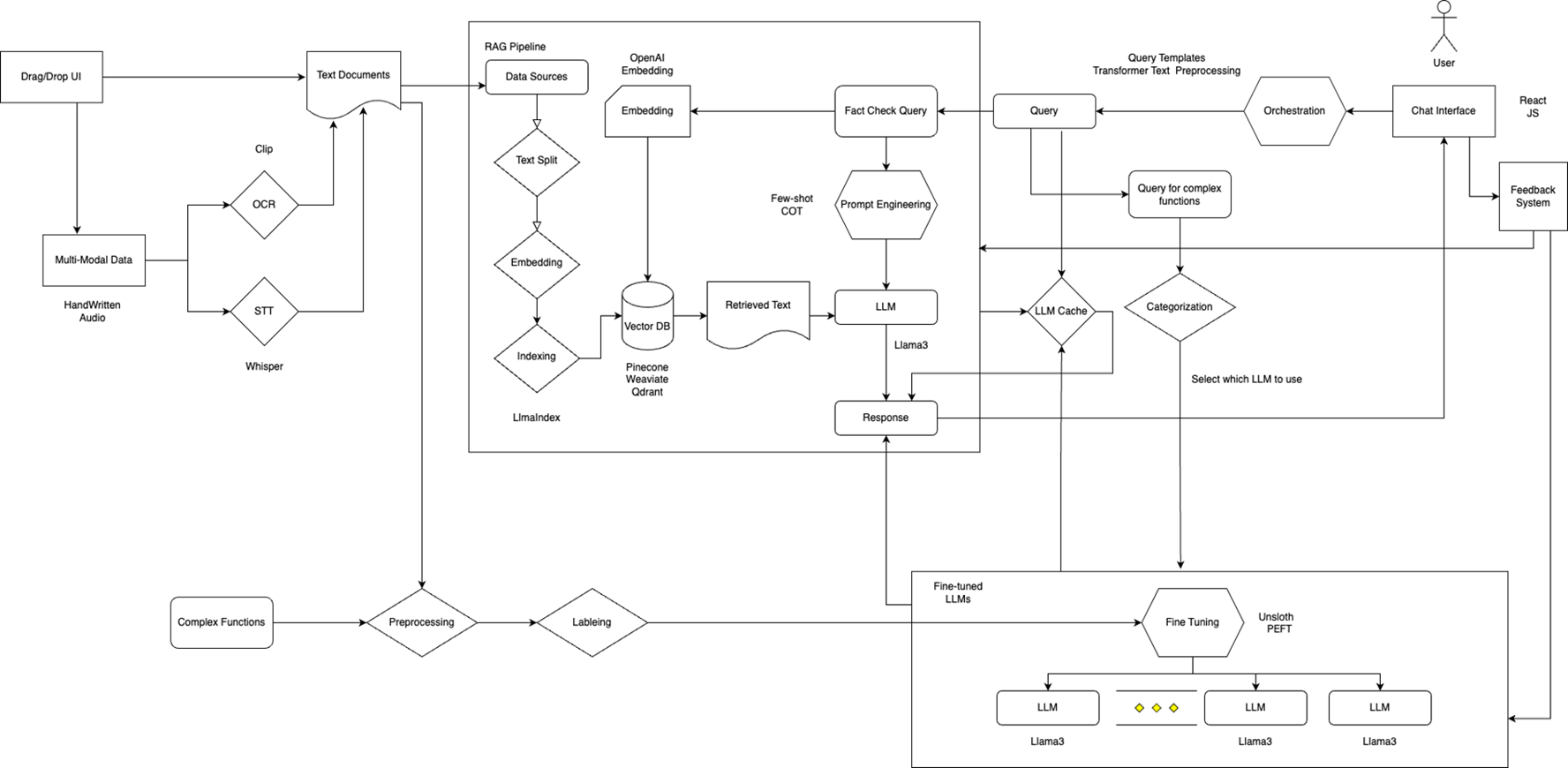
The end-to-end architecture spans multimodal ingestion (OCR, speech-to-text), a RAG pipeline (text splitting, embedding, vector DB, retrieval), fact-checked prompt engineering over fine-tuned Llama-3 models, an LLM cache, and a feedback loop from the chat interface.
Prompt logic & response tuning
AIKano defines explicit prompt-engineering logic and response requirements per use case – for example:
- Document comparison & evolution tracking – extract wording / coverage / scope changes; structured change summary with citations, no unsourced assumptions.
- Bias detection & inclusion-gap analysis – scan for missing representation (displaced, female, rural, differently-abled); neutral tone within Kano ethno-religious guardrails; data-driven gaps with mitigations.
- Inter-agency consistency check – 3-tier rating (aligned / partially aligned / conflicting) with harmonisation points.
- Regulatory gap identification – outdated terminology / missing coverage vs current benchmarks.
- Data extraction for dashboards – validated tables of entities, KPIs, budgets, with unit consistency.
Reproducibility
The project documents a 15-step process for reproducing the solution across other states and use cases – spanning mission targets, model-approach selection, a policy & routing gateway, knowledge labelling, retrieval, reliability engineering, security, quality/safety guardrails, piloting & measurement, systems-of-record integration, local-language & offline support, retention governance, and cost control from day one.
Relevance to NAISH
GovLLMiner is a working proof of offline-first, governance-tuned LLMs on local GPU. It validates the sovereignty and data-protection logic behind hosting AI on national infrastructure, and represents a use-case class – small, fine-tuned, locally-governed models – that maps naturally onto the NAISH node's shared compute and its AI governance and responsible-AI capabilities.
Project artifacts
Code base
AI-DPI Sandbox
DSN's AI-DPI Sandbox, Product Design and Technical Support project – a managed cloud environment and residency that helped Nigerian startups build AI on Digital Public Infrastructure.
GenAIGov
DSN's Generative AI Governance Readiness Assessment Platform (GenAIGov) – a self-assessment tool scoring AI governance maturity across the eight-part STANDARD framework.